I have a UX Design class (user-centered design) at Utah Tech and it has been a tough class. Considering it is only the second month of the semester, that's not a good thing. I think our professor could tell that we weren't happy with the class so she did something different. She had us make balloon animals using the instructions included in a kit. We had to work with another student. One of us made the animal using the "think aloud" process (where we described everything we were doing and thinking during the process) while the other person took notes and prompted us to keep talking if we ever went silent.
I was assigned to make the balloon animal - which ended up being a dog. The instructions were obviously translated from Japanese so they didn't always make sense but I was able to get a kind of normal-looking balloon animal out of it.
Needless to say, we all got a good laugh out of the process and it was a good break from all the craziness that was the class so far. The scariest part of the assignment was worrying that I would pop the balloon as I twisted it. The professor told me I couldn't pop the balloon but another student did, so I don't trust her anymore. haha!
I never thought I would be making balloon animals in my masters classes.
A little bit of information can be dangerous. I saw an advertisement for a free seminar on how to prune bushes, trees, etc. at Star Nursery. I signed up and went, along with 120 other people. It was crowded, the space was way too small, and you couldn't see what was being demonstrated, but I got a booklet with all the information. So I ate my donut, drank my chocolate milk, and left early.
I was excited because it was time to trim rose bushes, at least in Southern Utah. So I grabbed my trimmers and went to it. Unfortunately, the rose bush didn't want to be trimmed and it fought back. I wore two pairs of gloves (one gardening and one heavy-duty) and the thorns still got through. I wore a long-sleeved shirt and long pants and my arms and legs still had cuts all over them. But I won! The rose bush was trimmed. Now I am hoping I didn't kill it because I cut it back really far.
Utah Renewable Communities has set a goal to provide 18 communities in Utah with net-100% renewable energy by 2030. Communities in the URC program plan to pool funds and work with Rocky Mountain Power to purchase and develop new renewable energy sources. (Jack Matsen)
Utah Renewable Communities, a project pioneering efforts to provide net-100% renewable energy to local Utah communities, is on track for approval by the Utah Public Service Commission by the end of 2024.
The 18 cities participating in the program, including Salt Lake City, Moab, Park City and others, will work with Rocky Mountain Power to purchase and develop large-scale renewable energy projects. The energy from projects, such as wind and solar farms, would be used to provide residents with a default 100% renewable energy option for their homes, according to the URC website.
The end goal of the project, which began in 2018, is to have enough renewable energy projects developed by 2030 to offset the energy consumed yearly by each community, Luke Cartin, sustainability manager for Park City, said.
“We want to build on top of what Rocky Mountain Power produces,” Cartin said. “So let’s say that they’re at 50% renewable electricity by 2030. We’re going to go out and procure an additional 50% … we’ll see where the grid is going and we will go out and bring on additional renewable projects on top of what the grid has done.”
Christopher Thomas, senior energy and climate manager for Salt Lake City, said he expects the program to be approved by the end of 2024. Once approved, URC will focus on acquiring more renewable energy sources, he said.
“We really want to empower our residents (and) our businesses to be the positive change that they want to see in terms of the environment and the climate. And so we’ll really turn our attention to … the most cost-effective renewable energy resources that we can bring online to serve our participating customers,” Thomas said.
The URC website lists the end of 2024 as the date by which the program will be launched. The program is on track to meet that goal, but there are bills currently introduced in Utah legislature that prioritize non-renewable energy and could push back the timeline, Thomas said.
“We hope to submit the program application to the Utah Public Service Commission and have it approved later this year. However, the timeline could slip depending on how quickly we can reach agreement with Rocky Mountain Power on key issues or how long the Commission review process takes. We hope the program will launch by next year,” Thomas said.
According to the URC website, the average household participating in the program “will pay between $2 and $7 extra per month to have the amount of electricity they use every year matched with renewable energy by 2030.”
The program has not yet been filed with or approved by the Utah Public Service Commission, but once it is, communities such as Park City will begin informing residents about the program, Cartin said.
“Once the Public Service Commission gives us the stamp of approval … that’s when we send out the mailers and all those other things,” he said.
Customers will be able to opt out of the program if desired once notices of the program go out to the communities, according to the URC website. More information about the program will be available upon approval.
The weird weather continues in Ivins. We woke up to a lot of fog this morning. It is nice if you don't have to go anywhere but it's horrible to drive in.
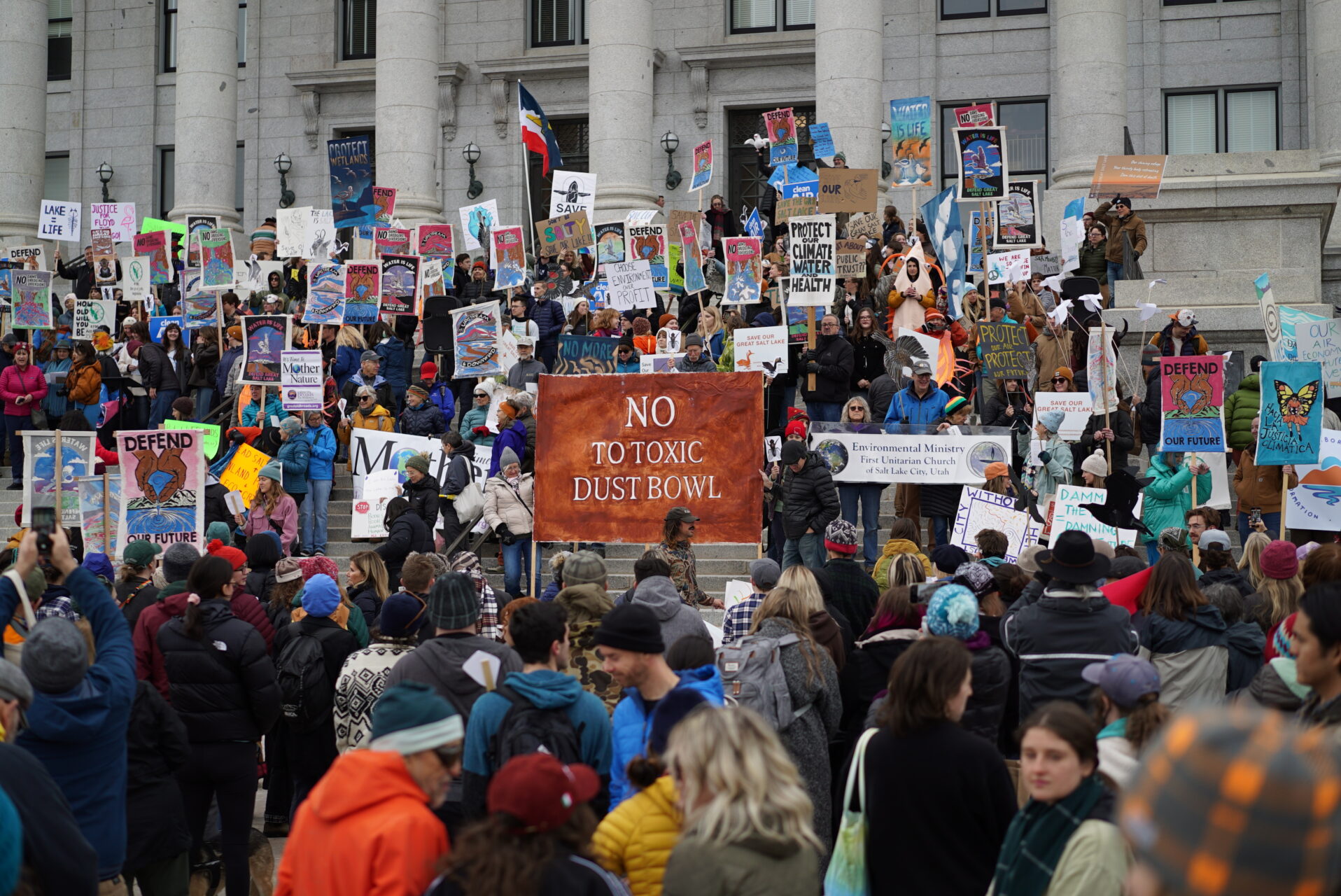
Rally attendees hold signs on the steps of the Utah Capitol building. The rally took place on Jan. 20, 2024. (Ethan Pack)
Hundreds of people gathered at the steps of the Utah Capitol building on Saturday, Jan. 20 to raise awareness and public support for the Great Salt Lake’s critically low water levels and sustainability efforts.
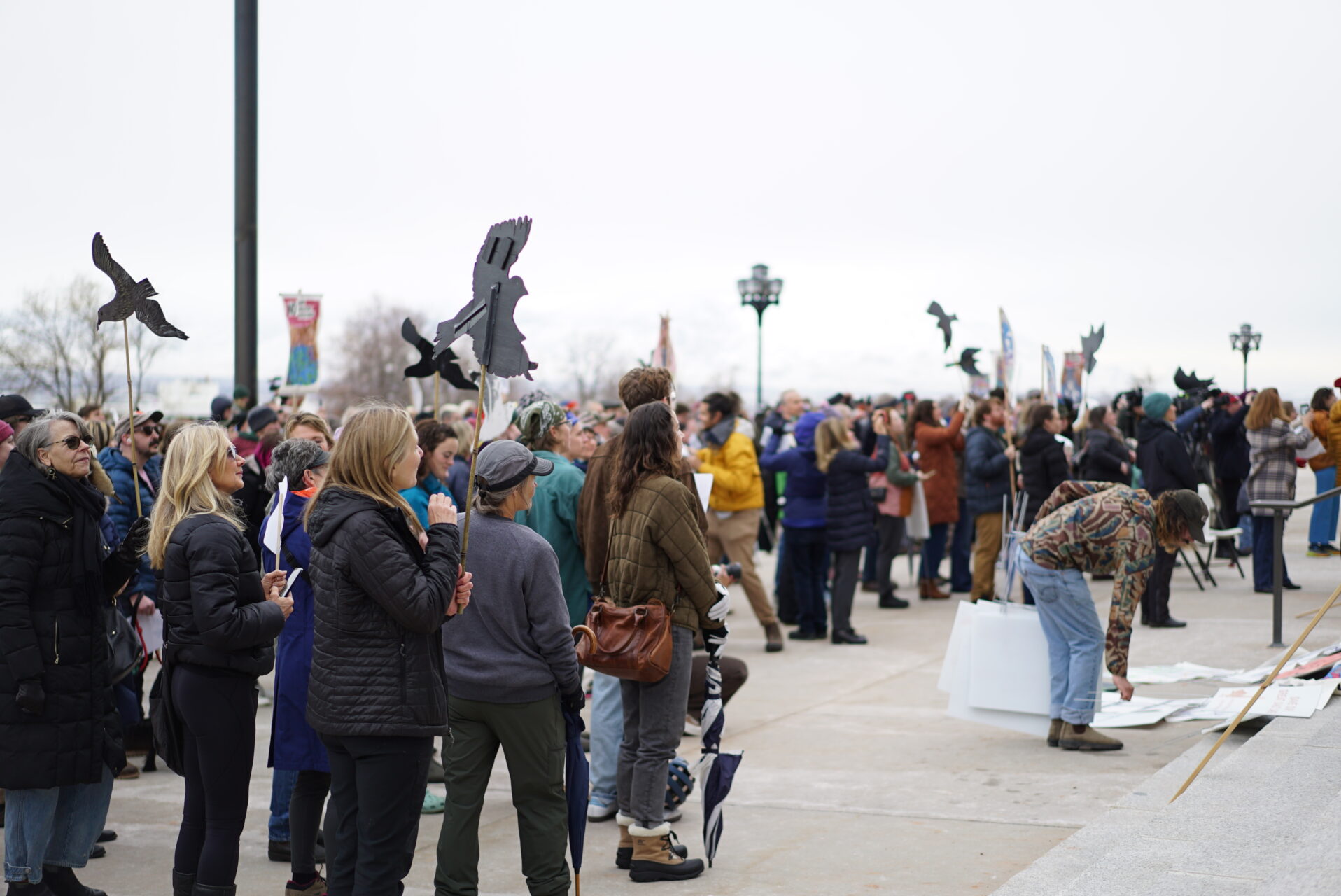
Participants carried signs, wore costumes depicting native wildlife and listened to local experts and leaders involved in sustainability efforts speak about ways to help fill the rapidly depleting lake. Local water security organizations set up information tables and handed out pamphlets about the Great Salt Lake.
“Yeah, the lake’s already mostly gone. We’ve lost two-thirds of its area and 75% of its water. So this isn’t something that will happen, it’s something that’s happening now,” Ben Abbott, executive director of Grow the Flow and professor of environmental science and sustainability at BYU, said.
The lake’s overall health has been in decline and is now at an all-time low due to Utah’s water needs, and organizations like Grow the Flow know greater action needs to be taken before the lake is past saving, he said.
Abbott said several major issues will arise if the Great Salt Lake continues to drop. The Great Salt Lake is a major source of brine shrimp, used to feed 45% of shrimp sold worldwide, as well as minerals such as magnesium and potash, the latter of which is used as an ingredient in fertilizers, he said.
Abbott said that were the lake to dry up, dust and harmful toxins collected in the lake’s sediment would become airborne, causing health issues such as asthma.
“One of the foundational ecological lessons that we’ve learned over the past 100 years is that there’s no separation between environment and society,” Abbott said.
Grow the Flow was formed after Abbott and a small group of researchers, lawyers and concerned citizens, published an emergency report in January 2023, detailing the Great Salt Lake’s situation. The organization seeks to involve Utahns in sustainability efforts and aims to develop an action network of 100,000 people who can assist in its mission, according to Grow the Flow’s website.
“We founded Grow the Flow to be an organization that everyone can participate in across political divides, across the urban/rural split, across different professions and backgrounds and levels of understanding,” Abbott said. “We wanted to create a place where everybody can participate.”
The rally was organized by Save Our Great Salt Lake, an organization aiming to raise awareness for the Great Salt Lake. Grow the Flow partnered with Save Our Great Salt Lake for the rally and other organizations, such as the Sageland Collaborative, Utah Food Coalition and SLC Air Protection.
Along with public outreach, members of Grow the Flow participate in research in order to gather data on the lake, said Rachel Wood, scientific director for Grow the Flow and a biology professor at BYU.
“I’m really excited about how much interest there is right now in the Great Salt Lake and how people really care,” Wood said. “That’s really encouraging to me because I think we’re the best hope for the Great Salt Lake.”
Wood said she researched Utah wetlands and saline lakes for the organization. She is currently working on a proposal for the National Science Foundation to obtain funding for a worldwide saline lake research network. Other saline lakes around the world are in similar situations as the Great Salt Lake, she said.
Several BYU students were in attendance at the rally, including students in Plant and Wildlife Sciences 480, a capstone course taught by Abbott.
“The lake itself has a right, not just the people drawing from it,” Alex Olson, a student in PWS 480, said. Olson said students in the capstone course hope to spread awareness about the degrading lake and plan on working this semester to do so.
According to Save Our Great Salt Lake’s official Instagram account, “The legislature has the power to make enormous strides to get water to Great Salt Lake, but it’s going to take a groundswell of community pressure to hold them accountable.”
The account shared a post stating that more than 1,200 people attended the rally and has plans for additional events during the state legislative session.
Rally attendees gather at the steps of the Utah Capitol building and listen to local leaders and experts talk about the Great Salt Lake. Some attendees held up signs and images of birds, others dressed up like local wildlife found in and around the lake. (Ethan Pack)
Since the SVU campus is on a hill, when there is snow they freak out. Actually, it is probably warranted but it's just funny to me. They had a digital day until 11 am and then all the classes after 11 am were in person. Except Courtney has the same professor for her 10 am class as she does for her 11 am class. Because he can't get to campus in 10 minutes, he held both classes digitally. So Courtney got to stay at home all day and take her classes online. A lot of students used the lids to bins as sleds and had a great time. Courtney stayed cuddled in her warm dorm room and watched the snowfall. She did go outside to go to the cafeteria for food but she froze.
Courtney has been told by many people that this is the coldest it has been in the past 5 years or so. It isn't the norm and she is happy to know that. Hopefully, it will warm up for her soon.
Ethan has a journalism lab class that is writing for the Daily Universe. His first article was a synopsis of the devotional address by Elder Nattress. It can be found by clicking here. I have also included the article below in case the link stops working.
I think he did a great job.
Elder K. Brett Nattress of the Seventy shares daily actions that can develop ability to ‘think celestially’
Elder K. Brett Nattress of the Seventy spoke to students and faculty about building their faith in Jesus Christ in a campus-wide devotional on Jan. 16.
Elder Nattress started his address by sharing a decision his young son made several years ago that resulted in a slight injury. Elder Nattress likened this decision to decisions we make in our lives that result in both physical and spiritual injury.
“We live in a fast-paced world full of distractions and deceptions that can hurt us. We also live at a time of great opportunity! This is a time that has been prophesied and anticipated by biblical prophets throughout the history of the world,” he said.
It is through Jesus Christ and His Atonement that those who experience this pain and sorrow can be healed, he said. According to Elder Nattress, the way to access Christ’s power is by “thinking celestially,” as President Russell M. Nelson has said.
“We will find peace and safety as we choose to think celestially. This is the key to receiving spiritual power from on high,” he said.
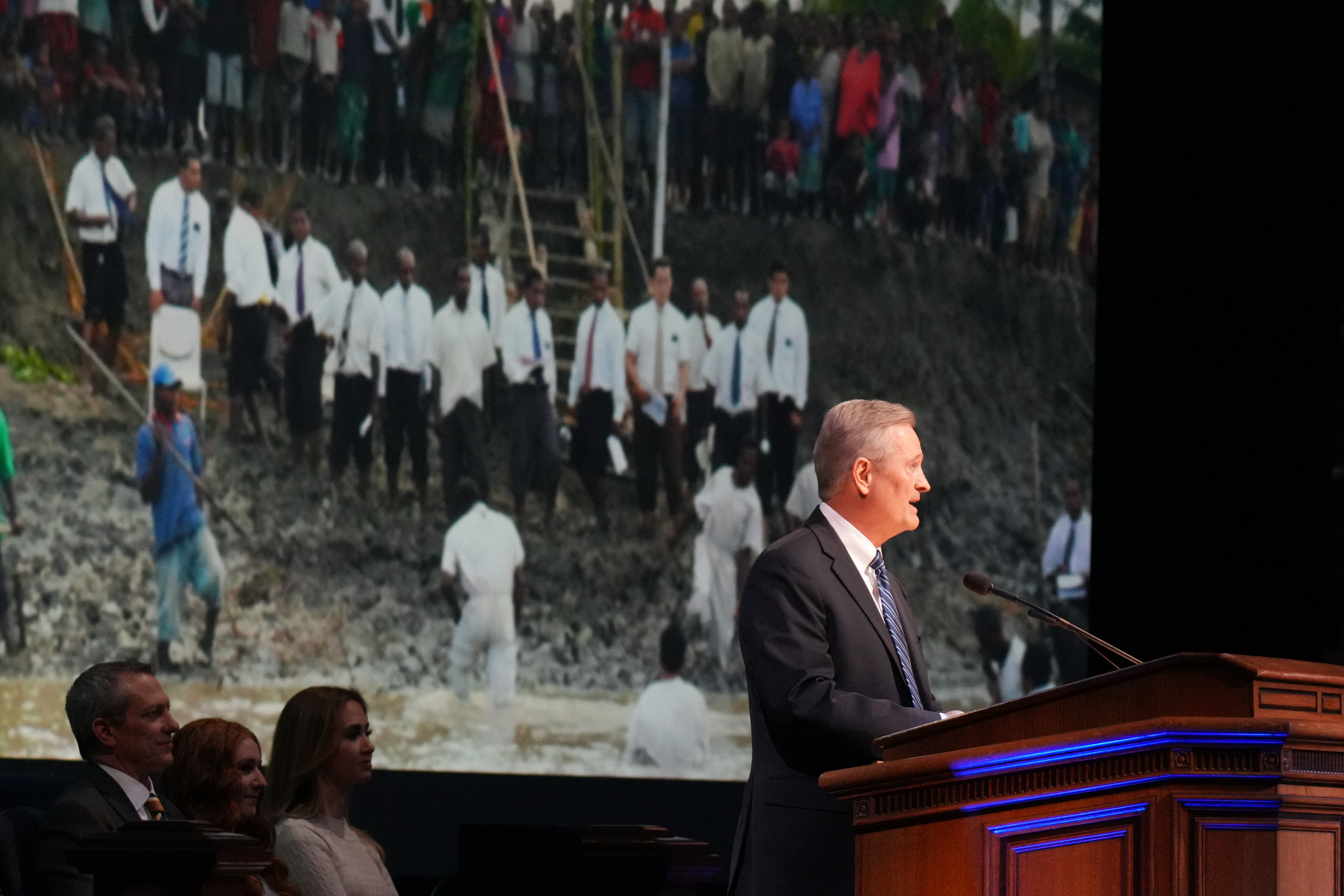
Elder Nattress spoke of the Abol family, whom he met in the Wadi branch of Papua New Guinea. The family waited for the Church for several years before being baptized and are now waiting for an opportunity to be sealed in the temple. They walk four hours one way to attend sacrament meeting each week, he said.
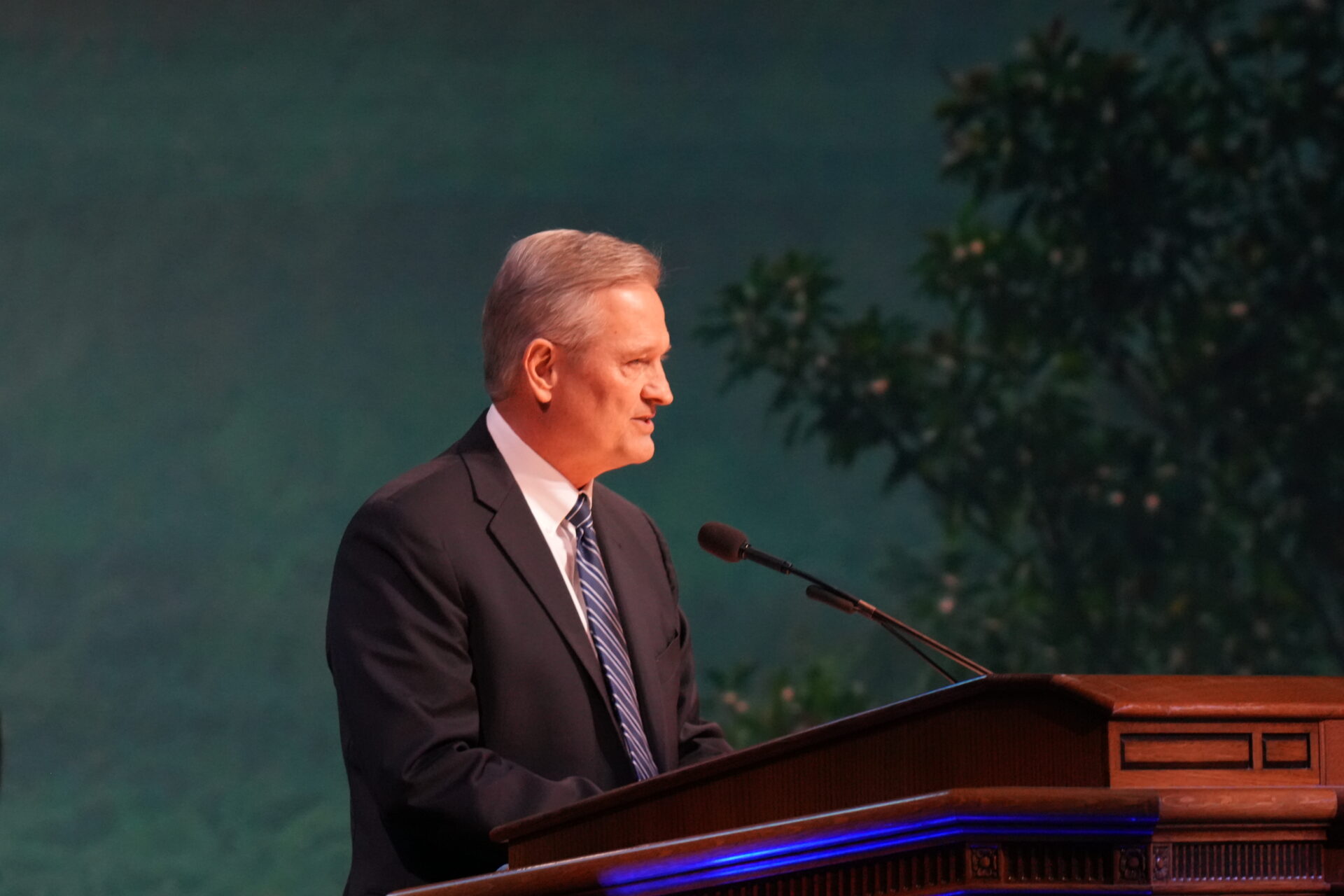
Elder Nattress speaks at the pulpit. He addressed students in the Marriott Center at a BYU devotional. (Ethan Pack)
“There is only one explanation why these saints endure so much and sacrifice so much each week. It is because they know that the gospel is true! They choose to always remember Him. They strive to think celestially,” he said.
Elder Nattress shared three daily actions and a weekly action, taught by prophets and apostles, that he said will “make an eternal difference in your life.” The three actions are to 1) pray every day, 2) read the Book of Mormon every day and 3) find someone to serve every day.
The weekly action is to partake of the sacrament, according to Elder Nattress.
“Remember ‘by small and simple things are great things brought to pass,’” he said, quoting Book of Mormon prophet Alma. He then promised blessings if students and faculty follow his counsel and take action.
“I know these measures sound simple and easy to do, but I promise that if we are faithful in these simple measures, we will find great joy and will be blessed with an increase of His Spirit to be with us,” he said.
Before closing his remarks, Elder Nattress shared a story of he and his wife serving as mission leaders in the Arizona Gilbert Mission. During their second year, Sister Nattress was suddenly diagnosed with stage 4 cancer.
While the experience was challenging for them, Elder Nattress said the Lord sent them an “angel” named Raquel, a member of the Church who was similarly suffering in the hospital.
“Over the next several months, Raquel became a close friend to Shawna … She would hold her hand, share her testimony, share her love and her time. She provided meals to our family and brought her daughters over to clean our house,” Elder Nattress said.
Elder Nattress standing in front of a photo of missionaries. He spoke to a crowd of students in a BYU devotional. (Ethan Pack)
Elder Nattress said Raquel was “thinking celestially” and had a grateful attitude toward God that was an inspiration to both him and Sister Nattress. He also shared Raquel was in attendance at the devotional and continues to be a light to those around her.
Elder Nattress reiterated the four actions he shared and closed with his testimony of the love Heavenly Father and Jesus Christ have for their children.



.JPEG)
.JPEG)
.JPEG)
.JPEG)